How Do Weld Nuts Create Permanent, High-Strength Joints?
The weakest point of a product is often the strength of the product in terms of industrial manufacturing and assembly of heavy-duty products. Average nuts and bolts fail to be effective when dealing with thin-gauge metals or the location in which a wrench cannot penetrate. Here the weld nut is a hero that is indispensable.
A weld nut is far more than a mere fastener, being a special type of nut that is intended to be permanently welded to a second piece of metal – typically a sheet metal component. It forms a threaded hole which is basically an extension of the base material itself and can survive even the most extreme vibrations, high torque and heavy loads.
Weld Nuts – What Are They?
Weld nuts are special-purpose fasteners that are welded permanently to a metal surface. They offer powerful and stable internal threads and so can be used in areas where the traditional nuts cannot be readily reached or attached.
A nut welder is a technology that is used to fix nuts permanently on metal components, which helps to create a reliable and strong connection.
Fun Fact: “The Little Bumps Matter a Lot — Most weld nuts have small raised projections (called pilot projections or weld projections). During welding, these tiny bumps concentrate the electrical current, melt, and collapse — creating an incredibly strong, precise bond. It's called projection welding.”
Types of Weld Nuts
The following are the weld nut types:
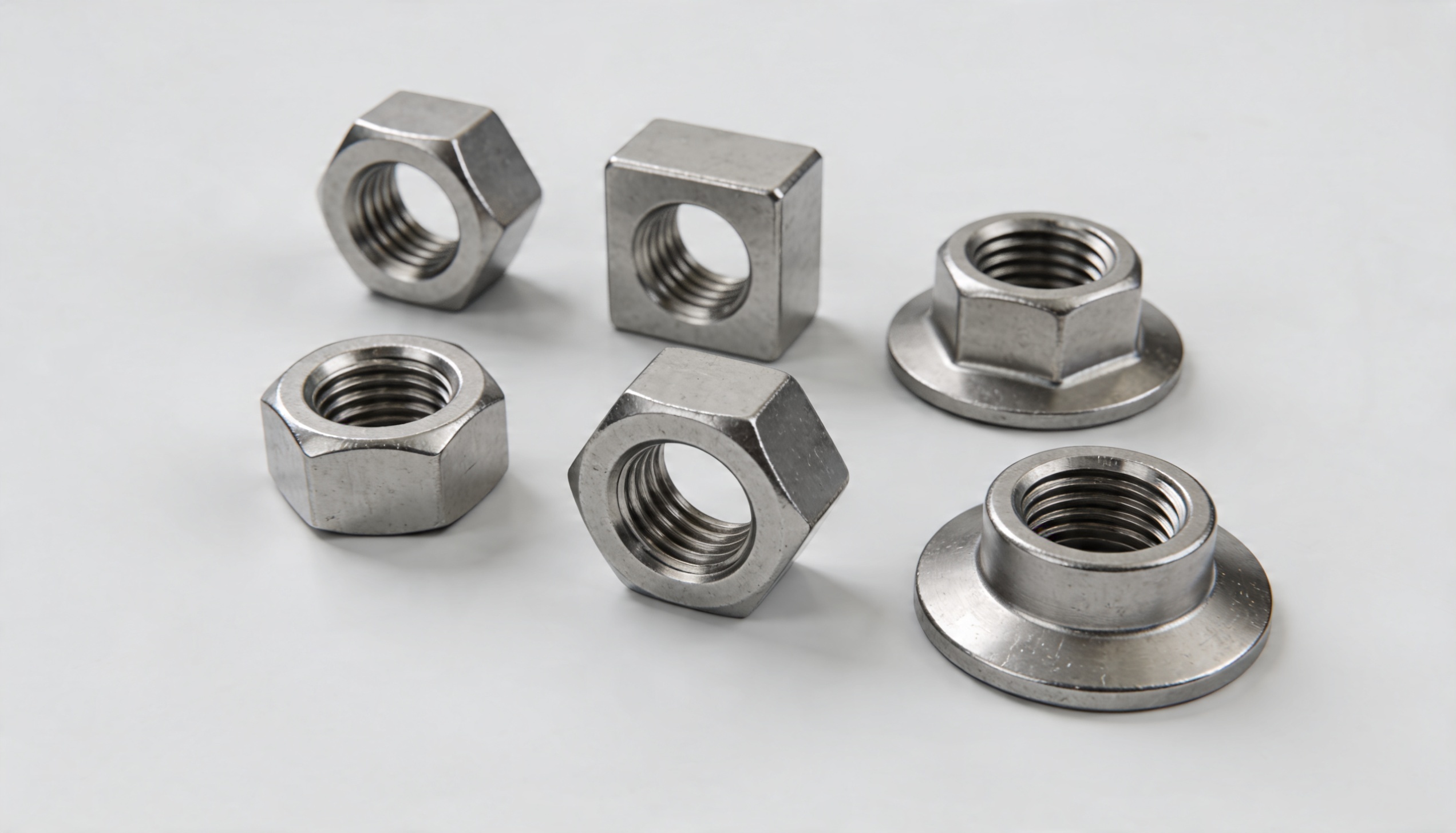
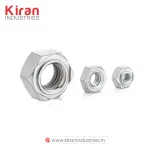
1. Hex Weld Nuts (DIN 929)
They are used for giving high strength and ensuring an even distribution of loads. They come in a standard hexagonal shape for high torque applications, like they are common in automotive frames.
2. Projection Weld Nuts
They are used for small projections that can melt during welding to make a secure bond.
3. Square Weld Nuts (DIN 928)
They provide strong resistance to torque because their flat sides prevent it from rotating, and it helps to provide better resistance to rotation.
4. Spot Weld Nuts
They are designed for thin sheet metals.
5. Round Base Weld Nuts
They are applied in a limited space where smooth contours are needed, which makes it ideal for smooth and flush installations.
6.Tab Weld Nuts
They include tabs to assist in positioning before welding.
7. Flange Weld Nuts
They have wide bases which help offer a larger bearing surface for even load distribution.
8. Long Projection Weld Nuts
They are designed for stronger welds with deeper projections.
Welding nuts which are commonly referred to as 'weld nuts', allow easy bolt installation without needing access.
About Kiran Industries
‘Kiran Industries was started in 1985 and it is located in Rajkot, Gujarat and is a reputed manufacturer of industrial fasteners, including bolts, nuts and customised fastening solutions. The company has been serving different industries such as automotive, construction, aerospace and engineering with more than forty years of experience. It is known to be highly quality-orientated with a high level of manufacturing plants, internal testing laboratories and ISO-certified processes. Kiran Industries focuses on accuracy, longevity and reliability of its products at the same time, delivering customer satisfaction and timely delivery. Its innovation and adherence to international standards have contributed to developing long-term trust and a good reputation in the fasteners sector.’
Applications of Weld Nuts
Here are some of the applications of weld nuts:
- Automotive Industry
- Sheet Metal Fabrication
- Electrical Enclosure
- Furniture Manufacturing
- Industrial Machinery
- Construction Equipment
Weld nut welding is an integral part of the structure which eliminates the need for manual fastening.
Here is another blog you might be interested in.
Top 10 Applications of Copper Bolts
Technical Specification
The following table talks about the technical specification of weld nuts.
| Parameter |
Specification |
| Product Name |
Weld Nut |
| Standard |
DIN 928 / DIN 929 |
| Type |
Projection Weld Nut / Spot Weld Nut |
| Thread Type |
Metric Thread (Coarse / Fine) |
| Thread Size |
M4, M5, M6, M8, M10, M12, M16 |
| Nominal Diameter |
4 mm to 16 mm |
| Material |
Low Carbon Steel, Stainless Steel (SS 304 / SS 316) |
| Grade |
Class 8 / Class 10 / A2 / A4 |
| Surface Finish |
Plain, Zinc Plated, Hot Dip Galvanized, Black Oxide |
| Coating Thickness |
5–25 Microns (Zinc Plating) |
| Corrosion Resistance |
Moderate to High (depending on coating) |
| Shape |
Square / Hexagonal / Round Base |
| Welding Type |
Projection Welding / Resistance Welding |
| Applications |
Automotive, Sheet Metal Fabrication, Machinery, Construction |
| Strength |
High Mechanical Strength |
| Hardness |
As per standard requirements |
| Temperature Resistance |
Up to 400°C (Material dependent) |
| Customization |
Available as per drawing or sample |
| Packaging |
Bulk, Box Packing, Export Packing |
| Country of Origin |
India |
Working Process of Weld Nuts
The working process of a weld nuts are as follow:
Step 1: Surface Preparation
The base metal surface is cleansed prior to weld nut welding to eliminate oil, rust and contaminants. Electrical conductivity becomes seamless on a clean surface.
Step 2: Positioning the Weld Nut
The chosen fastener among the Weld nuts types, including: Hex Weld Nuts (DIN 929), Square Weld Nuts (DIN 928), or Round Base Weld Nuts, is laid correctly on the metal surface. The correct positioning is an important factor in ensuring the accuracy of the thread and load distribution.
Step 3: Application of Heat and Pressure
With a Nut welder, the electric current is passed through the weld nut and the base metal. The projections (small raised points) on the types such as Long Projection Weld Nuts focus the heat to certain points. At the same time, pressure is used to make sure that there is close contact between surfaces.
Step 4: Material Fusion (Weld Formation)
The high local heat fuses the projections and a film of the base metal. This forms a metallurgical bond, between the two materials, fusing them together. The broader base in Flange Weld Nuts can be used to evenly spread heat, increasing the strength of the joint.
Step 5: Solidification and Joint Formation
In the absence of power, the molten material cools down. This results in the formation of a solid joint.
Step 6: Strength Through Proper Weld Nut Dimensions
Some of the factors that contribute to the creation of high-strength include projection size, thickness and thread design. Standard dimensions lead to consistency and reliability.
Step 7: Industrial Quality and Supply
The major Weld Nuts Manufacturers in India are developing weld nuts with specific projections and materials to maximize the performance of welding. Welding Nuts Dealers in India are very reliable and make sure that quality products are available to maintain consistent joint strength.
Choose reliable weld nuts dealers in India who know the working process and applications which ensure right use.
Did you know? “World War II Accelerated Everything — Military vehicle and aircraft manufacturing during WWII drove enormous innovation in weld nut technology. Speed and reliability in assembly were literally life-or-death concerns, pushing manufacturers to standardize projection welding processes.”
Why Choose Kiran Industries for Weld Nuts?
Here are some of the reasons:
- They ensure durable finishing.
- They supply custom weld nuts.
- They have standard bulk sizes.
- They provide safety in structural and mechanical loads.
As the leading weld nuts manufacturers in India, they ensure that products provide long-lasting performance and durability.
Conclusion
Weld nuts are those tools that can be seen everywhere in our daily lives. They make the cars we drive, the appliances we use, and the heavy machinery that constructs our world; their temporary mechanical bond becomes a permanent molecular bond, giving it the structural integrity it needs.
The weld nut continues to be the gold standard in forming high-performance joints in sheet metal when strength, longevity, and efficiency in assembly are the main concern. It is not only in the case of the high-speed rail car, but also in the case of the basic server rack; the physics of the weld nut will guarantee you a product that is constructed to withstand. Kiran Industries is the best platform.
If you consider investing in weld nuts, then Kiran Industries is the right choice. The brand also deals in brass bolts, copper nuts, brass nuts and much more. Contact us now.