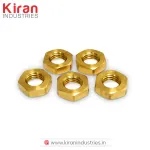
Not all nuts are made equal, and selecting the wrong product can flip a good build into a maintenance nightmare fast. Whether you're working with sheet metal, wires, or simply trying to keep a piece of machinery functioning trouble free, knowing which of our Weld Nut, Brass Nut, or Copper Nut Bolt to use is more important than most buyers understand.
This blog guide to Industrial Nuts gives you the info you need to make your next order more calculated and less uncertain.
Why Choosing the Right Industrial Nut Matters
Here's the reality - a nut is not just a nut. What's best here supports your joint, provides corrosion resistance, and prevents downtime you don't want. The variety of materials and fastening styles in Industrial Nuts tells you there's no such thing as one size fits all: your operating conditions, application, and load determines what you'll get in the end.
You can jump the gun here and you may as well be rolling the dice with your equipment's future. The smart operators treat them as engineering and not an after thought - and that mindset differentiates reliable construction from those who are always calling their Nuts and Bolts Manufacturers.
What Is a Weld Nut And How Does It Work?
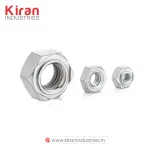
So, What Is a Weld Nut? Basically, it's exactly what you think it is-a nut attached to a part on the manufacturing floor so it no longer moves. This is done through a process called Nut Welding, during which pressure and heat are used to quickly weld the nut on to the workpiece so that a secure threaded connection can be maintained. This makes the nut part a permanent part of the workpiece, providing a reliable and stable fixture for fasteners to be screwed into without ever coming loose.
Common Applications of Weld Nuts
They will be found all over where manufacturing lines have to zip along quickly, and accuracy is key:
- Sheet-metal fabrication for enclosures and panels
- Automotive body and chassis components
- Heavy machinery frames and brackets
- Industrial equipment housings and assemblies
These use cases rely on Weld Nuts for their ability to sustain vibration and load and can do so without the additional hardware, which makes them a go to for our Industrial Fasteners installations of comparable needs.
Key Benefits of Weld Nuts
After being welded, these nuts can't be moved — not even by a micrometer. Here's why fabricators never let up on their pursuit of them:
- A reliable and stable mounting system on the workpiece.
- Quick assembly, as there is no need to align loose nuts
- Improved access in confined or inaccessible areas
- Designed for high-volume production facilities
In essence, a Welded Nut setup eliminates an entire step from your assembly line – and that's quite a significant advantage when speed is the name of the game. The Welding Nut process itself is fast too, ensuring no production bottlenecks.
When Should You Choose Brass Nuts?
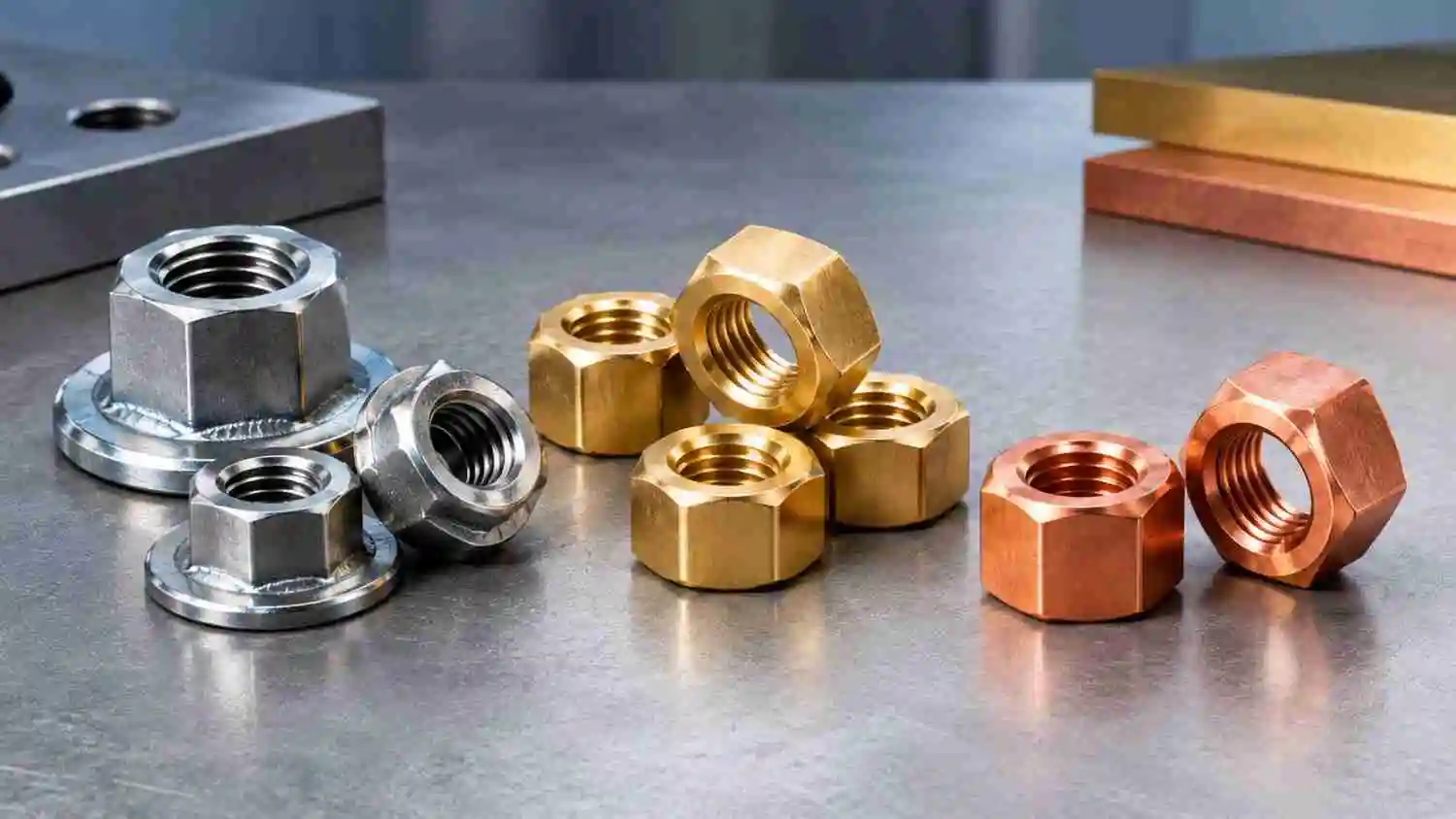
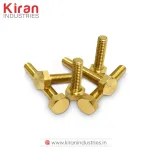
Brass has to be the underappreciated hero of non ferrous fasteners, ngl. A Brass Nut has corrosion resistance galore, and is also quite machinable so as to create refined, meticulous threads, which you certainly want in an industrial fastener with tight tolerances.
It's widely regarded as the easiest nonferrous nut to work with for electrical fittings and plumbing/ instrumentation systems where corrosion isn't wanted but don't necessarily need to be exploited. Small equipment parts that are exposed to the elements or can be subject to trace amounts of water and chemicals will be better off with Brass Fasteners.
Weld vs Brass vs Copper Nuts: Key Differences
Still deciding between the three? Let's take a quick look at the summary before you order:
| Feature |
Weld Nut |
Brass Nut |
Copper Nut |
| Material |
Steel/alloy |
Brass alloy |
Pure copper |
| Fastening Method |
Welded permanently |
Threaded |
Threaded |
| Conductivity |
Low |
Moderate |
High |
| Corrosion Resistance |
Moderate |
High |
High |
| Typical Use |
Fabrication, automotive |
Plumbing, instrumentation |
Electrical, earthing |
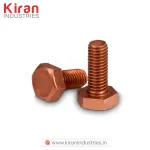
The bottom line is that weld nuts outperform Copper Nut Bolt options for structural purposes and vice versa for electrical. It's all about matching material to application – that is the whole game of Industrial Nuts selection.
Key Factors to Check Before Buying Industrial Nuts
Before finalizing an order, go through these essentials so you don't end up with a failed batch:
- Confirm material suitability for your operating environment
- Verify thread size and bolt compatibility upfront
- Check quality certifications and manufacturing tolerances
- Ask about bulk pricing and lead times
Purchasing teams and OEM buyers that jump straight to placing the reorder may find that this is when the problems come home to roost – clever sourcing from reputable Nut Bolt Suppliers and a trusted Nut Bolt Manufacturer can help save time as well as money.
-
Material and Operating Conditions
Moisture, chemical exposures, temperature variations, electrical requirements - your conditions will dictate your material selection. A humid coastal plant in need of corrosion resistance might select a Brass Nut or Copper Nut, while a dry indoor production line with a substantial structure is more apt to prefer a Weld Nut. Use the material based on conditions, not spec sheets!
-
Thread Size, Dimensions and Bolt Compatibility
It's an obvious newbie error to get a pairing of Nut Bolts wrong. When ordering in bulk, please always double check thread type, thread diameter and pitch against your bolt specifications: if not, you're wasting stock and time.
-
Quality Standards and Manufacturing Accuracy
When it comes to industry standards, it's impossible to compromise with dimensional accuracy. Be sure to verify consistent material type, standards and testing methods. Reliable Nuts and Bolts Manufacturers are willing to provide this information without you asking for it.
Nut vs Washer: What Is the Difference?
Another common one that gets people confused is that a nut is used to hold a threaded assembly together, a washer is used to spread the load, to protect surfaces or to provide locking support. The Nut vs Washer debate isn't a debate, it's a team discussion! Typically, they are used in combination: the washer to prevent damage to the surface and to loosen, and the nut to secure.
How to Select a Reliable Nut Bolt Manufacturer & Supplier
In the same manner not all suppliers are made the same, here is actually your list for determining whether a vendor is worth signing off on.
- Manufacturing capability and capacity demonstrated
- A wide range of products, from materials and sizes.
- Specific project needs can be met with customization options.
- Good quality control; quality testing in place.
- The capacity to produce in bulk, and with consistent quality.
- Ensuring there is appropriate documentation and certifications.
- Dependable delivery timelines
When it comes to sourcing at scale, it's not just the price that matters; a reliable Nut Bolt Manufacturer in India should also ensure that their capabilities, consistency, and communication align with the requirements. It's this kind of reliability that has earned Kiran Industries a reputation for excellence and made it a reliable choice for so many buyers that they continue to come back without looking elsewhere. If you're doing your research on vendors, then Kiran Industries should be at the top of your list.
Conclusion
There is no best choice for nuts; weld nuts, brass nuts and copper nuts can all be used for different purposes, depending on the job. When you make the decision to order, review the quality of materials, workplace, and technical specifications without getting to your supplier's word for it, but with proof.